3-4 Minutes
ESG as an Equity Value Driver: Lower Risk, Lower WACC, Higher Valuations

Hubert Abt - CEO & Founder
Empirical research increasingly shows that strong ESG performance is correlated with lower systematic risk, reduced default probability, and tighter credit spreads all of which feed directly into a lower cost of equity and debt. Many studies indicate that high-ESG firms exhibit lower beta and can achieve 10–20% reductions in WACC, materially lifting discounted cash-flow valuations.
Companies with strong governance and environmental efficiency also tend to deliver measurable cost savings, fewer operational disruptions, and reduced information asymmetry, which together broaden the investor base and increase price stability. This strengthening demand from institutional and sustainability-focused investors reinforces the valuation premium often observed in ESG-aligned equities. Market behaviour increasingly mirrors these fundamentals.
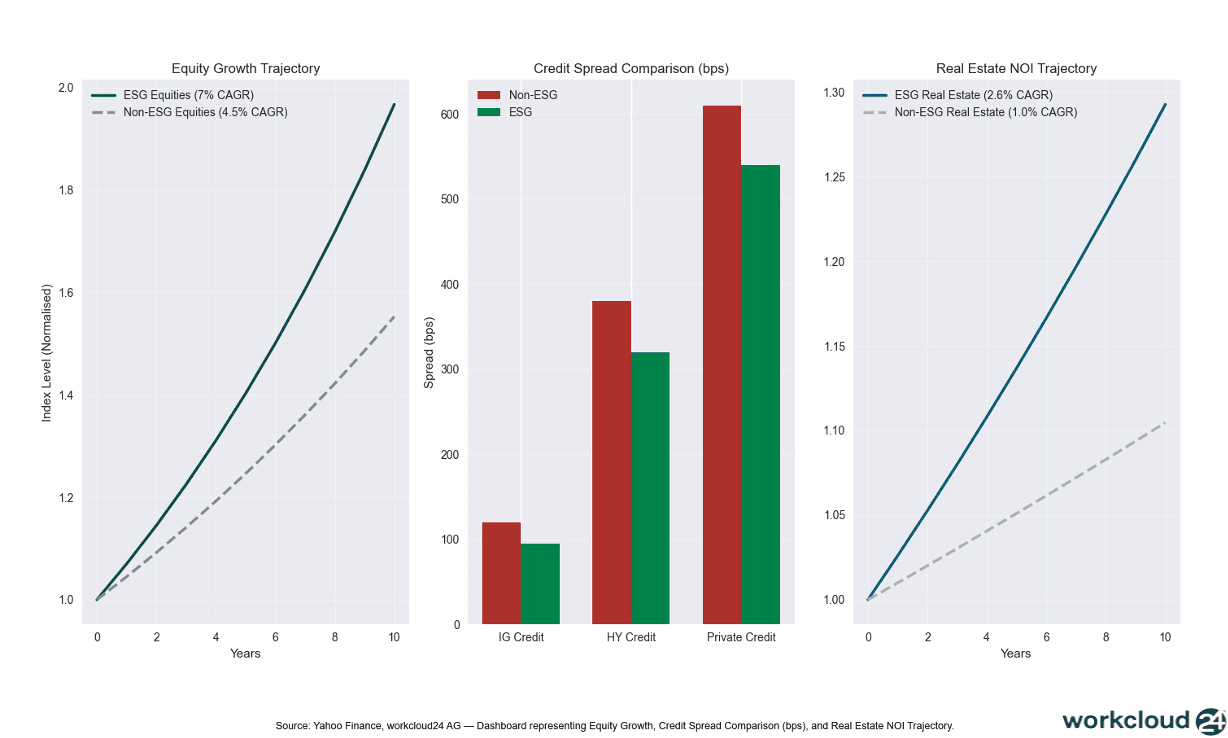
High-ESG companies frequently command valuation uplifts due to lower perceived risk and stronger long-term earnings visibility. Research shows positive correlations between ESG scores and profitability metrics such as ROE and operating margins, reflecting enhanced internal processes and better risk management. ESG-led innovation and regulatory readiness further improve forward-looking cash flows, reducing uncertainty that typically compresses multiples.
While impacts vary across sectors, the overall data trend is clear: ESG has evolved from a cost centre into a structural equity value enhancer, driving resilience, higher earnings quality, and more attractive risk-adjusted returns.
See more articles
Lorem ipsum dolor sit amet, consectetur adipiscing elit, sed do eiusmod tempor incididunt.
Ready to get started?
Skip the guesswork. Book a direct strategy call to find out exactly how much valuation upside and operational savings your portfolio is hiding.