Sustainability Is Now a Credit Metric: The New Performance Divide in CRE
December 2, 2025
3-4 min

Across the European commercial real estate market, performance differentials between ESG-aligned assets and the rest of the market are becoming more quantifiable and relevant to capital decisions. High-rated buildings are now consistently delivering rental and pricing uplifts in the +3.7% to +7.5% range, supported by stronger tenant retention, lower vacancy, and materially better operating efficiency.
Lenders: this translates into clearer income visibility and reduced covenant risk.
Investors and Asset Managers: these premiums are increasingly being priced into acquisition underwriting, exit assumptions, and portfolio optimisation strategies as sustainability shifts from a qualitative overlay to a financial performance driver.
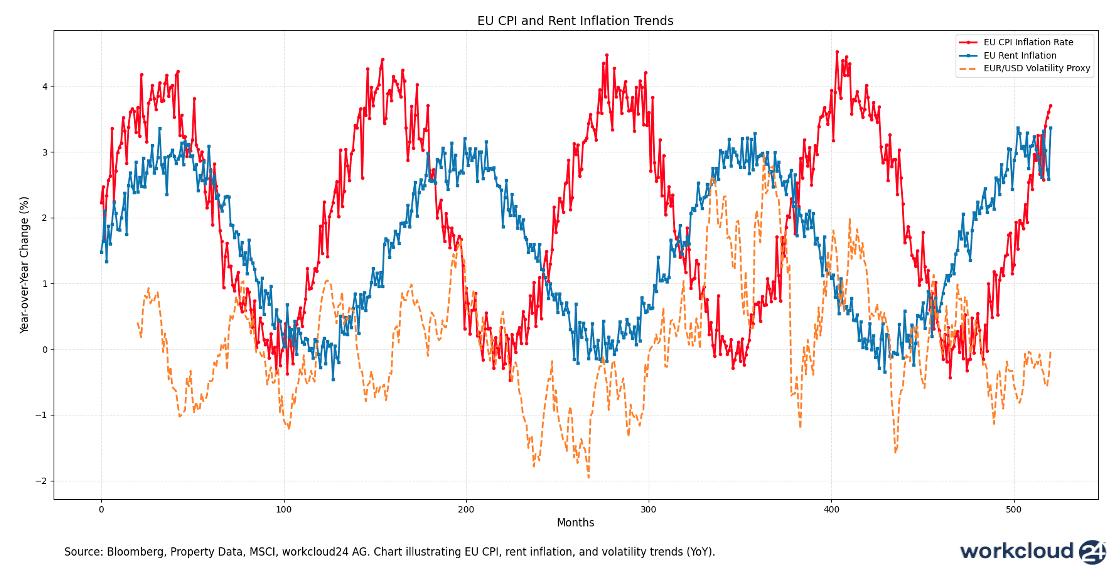
At the macro level, EU CPI and rent inflation trends illustrate why these figures matter for capital allocation. Headline inflation remains volatile, while rent inflation exhibits a more structural, slower-moving profile. ESG-aligned assets are typically more energy-efficient and less exposed to regulatory risk which show reduced sensitivity to these inflation cycles.
This stabilises cash flows, lowers refinancing risk, and supports more predictable long-term performance. In a market where cost of capital is acutely tied to perceived risk, sustainability performance has become a measurable differentiator. For lenders, investors, and asset managers seeking resilient yield profiles, ESG is no longer a thematic add-on, it is a pricing signal, a risk mitigation tool, and an increasingly central component of value.

Author of this Article
Hubert Abt - Founder & CEO
INSIGHTS & RESOURCES
See other interesting news
Sed ut perspiciatis unde omnis iste natus error sit voluptatem accusantium doloremque laudantium, totam rem aperiam.
Want to learn more?
Book a free consultation with Hubert!
During the call we will explain the process in details and answer any extra questions you may have